






Lights and heat: wood, rattan, paper and fabric, the right reflexes
 By the Alméa team
7 min read
Sommaire
Lights and heat: with a shade made of wood, rattan, paper or fabric, the question is not whether it is dangerous, but how to fit it out properly. An LED bulb, enough distance between the bulb and the material and respect for the stated maximum wattage are enough to enjoy these warm materials with peace of mind.
Natural materials give a soft, filtered, lively light. They also have something in common: they do not like heat. Wood can split or darken, rattan can dry out, paper and fabric can yellow and then scorch if the bulb is too close.
Here are the practical guidelines for choosing the bulb, reading the label and fitting each material in the right place.
Contents
1. Lights and heat: why the question arises
A bulb turns electricity into light, and part of it into heat. The bigger that part, the hotter the air and the material around the bulb become. With a glass or metal shade, this is not a problem. With a combustible material, you need a margin. The right reflex comes down to three words: LED, distance, label.
2. Not all bulbs get equally hot
For the same light, the technologies are nothing alike. An old 60 W bulb gave off most of its energy as heat. An 8 W LED gives comparable light with a fraction of that energy. To check the equivalents, see our lumens, watts and kelvins decoder.

| Technology | Wattage for about 800 lumens | Heat felt | With a natural material |
|---|---|---|---|
| Incandescent | About 60 W | Scorching | Best avoided |
| Halogen | About 42 to 53 W | Very hot | Not to be used |
| Compact fluorescent | About 13 to 15 W | Lukewarm | Possible, but outdated |
| LED | About 7 to 9 W | Lukewarm at the base | Recommended |
The LED filament bulb keeps the retro charm without the heat of the past: see the LED filament bulb.
3. The stated maximum wattage: read it and respect it
Every light with a lampholder carries a marking such as “max 40 W” or “max 60 W”, on the label, in the instructions or near the lampholder. This figure is a heat limit, set for the material and shape of the light. It applies to the power the bulb actually uses, not to its equivalent.
- An 8 W LED in a “max 40 W” light: perfect.
- A 53 W halogen in a “max 40 W” light: not allowed.
- An 8 W LED sold as “60 W equivalent” in a “max 40 W” light: perfect, only the 8 W count.
4. The distance between bulb and material
Even an LED should not touch the material. Its glass stays lukewarm, but its base and electronics heat up. The bulb should be centred in the shade, not touching it, with a pocket of air that lets the heat rise and escape.
| Lampshade | Recommended bulb | Distance guide |
|---|---|---|
| Small fabric or paper shade, under 20 cm | LED 4 to 6 W, E14 or E27 | Bulb centred, never touching |
| Medium woven pendant, 30 to 40 cm | LED 7 to 9 W, E27 | Several centimetres of air all round |
| Large pendant or lantern | LED 9 to 12 W, E27 | Bulb in the centre of the volume |
| Wall light with a wooden cover | LED as per the instructions | Strict respect of the maximum wattage |
Our warm white E27 LED bulbs and our warm white E14 LED bulbs suit lights with these fittings. To identify yours, read our guide to the E27 bulb.
Woven pendants designed for soft, filtered light.
Discover our rattan pendant lights5. Wood: noble, but sensitive to drying out
Wood copes well with an LED. With a bulb that is too hot, it dries out, splits or darkens around the lampholder. On a wooden wall light, check that the lampholder is insulated from the wood by a ceramic or metal part. Our wooden wall light guide and the one on the wooden pendant light present the woods and shapes.
6. Rattan, bamboo and woven fibres
Woven fibres let air circulate, which helps carry heat away. But a dry fibre catches fire more easily than solid wood. LED is a must, the bulb should be centred, and never use a bulb bigger than the opening allows. The guides to the rattan pendant light and the straw, raffia or jute pendant light complete this advice.

7. Paper: light and very reactive
Paper is the most sensitive material. It yellows with heat and can scorch if it touches a bulb. Choose a low-wattage LED, check that the frame holds the paper well away, and never let the lantern sag onto the bulb.

8. Fabric and linen
A fabric or linen shade is often lined with an inner film that stiffens it. This film does not like heat: a halogen makes it yellow and warp. With an LED, the shade keeps its colour. Dust it regularly, as built-up dust does not like heat either.
9. Integrated LED: a special case
On a light with integrated LED, there is no bulb to choose: the manufacturer has sized the source and its heat dissipation for the material. The heat is concentrated on a small heat sink, often made of metal. See our comparison integrated LED or replaceable bulb.

10. Warning signs
A properly fitted light stays unobtrusive. Several signs should make you switch off and check: a hot or burning smell, a brown mark on the shade, a discoloured lampholder, a hardened cable near the lampholder, a crackling sound. Our article wall light getting hot helps you tell lukewarm from abnormal.
| Sign observed | Likely cause | What to do |
|---|---|---|
| Hot or burning smell | Bulb too powerful or touching the material | Switch off, let it cool, switch to an LED |
| Brown mark on the shade | Bulb too close | Replace the damaged shade, recentre the bulb |
| Discoloured or cracked lampholder | Repeated overheating | Have the lampholder replaced |
| Hardened or cracked cable near the lampholder | Past heat damage | Stop using it, have it rewired |
| Crackling | Poor contact or unsuitable bulb | Switch off, check the bulb and the lampholder |
Wood brings its warmth without needing to get hot.
See our wooden wall lights11. In short
Wood, rattan, paper and fabric go very well with light on three conditions: an LED bulb, a pocket of air around the bulb and respect for the stated maximum wattage. Add a regular look at the shade and the lampholder, and these materials will stay with you for a long time.
Frequently asked questions
Which bulb for a fabric lampshade?
An LED bulb, preferably warm white, whose actual wattage stays below the stated maximum. It must be centred and never touch the fabric.
Can an LED bulb set a lampshade on fire?
The risk is very low with a properly fitted LED, as it gives off little heat. It increases if the bulb touches the material or if the lampholder is faulty.
What does “max 60 W” mean on a light?
It is the maximum actual wattage of bulb that the light can take without overheating. An 8 W LED is well within this limit, even if it is sold as “60 W equivalent”.
Can you put a halogen bulb in a rattan pendant?
No. A halogen gets far too hot for a natural fibre. Replace it with an LED with the same fitting.
Why is my paper lampshade turning yellow?
Heat and light make paper yellow over time. A bulb that is too powerful or too close speeds this up: switch to a lower-wattage LED.
How many watts for a bamboo pendant?
A 7 to 9 W LED is generally enough for a medium-sized pendant. Always check the maximum wattage shown on the light.
Does a wooden wall light heat up the wall?
With an LED, the heat stays very moderate. With an old incandescent bulb, the wood and the wall around it can get noticeably warm.
What distance between the bulb and the lampshade?
There is no single figure: the bulb must be centred, not touching, with air all round. Stick to the bulb shape and size intended by the manufacturer.
Our lights for your home
Stone, wood, metal, rattan: real materials. Free delivery across the UK, returns within 90 days.
 -36 %
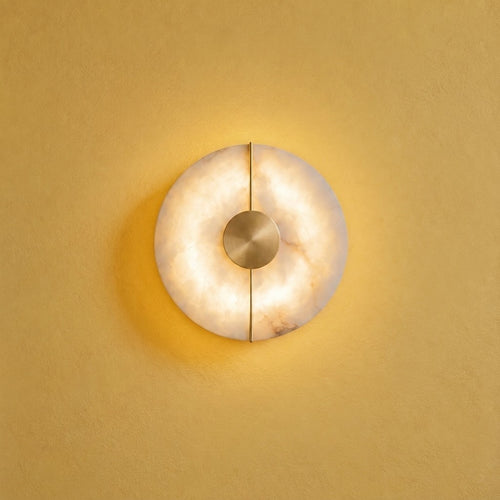
Marble wall light for bedroom, natural stone, alabaster white
£110.00
 -38 %
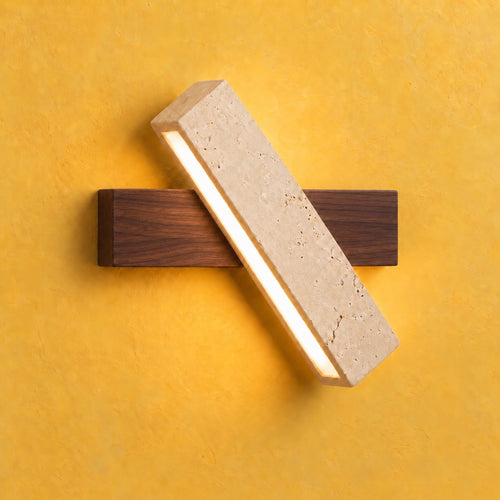
Natural stone wall light for living room, ambient lighting
£101.00
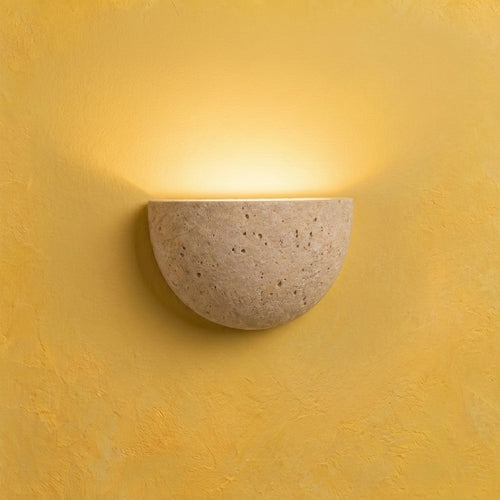 -42 %
Travertine wall light for bedroom, natural stone, retro
£129.00
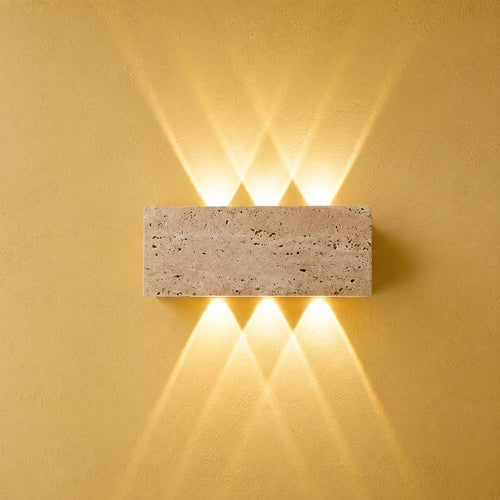 -38 %
Travertine wall light for living room, natural stone, wabi-sabi
From £101.00
 Inspiration
 Room by room
 Inspiration