


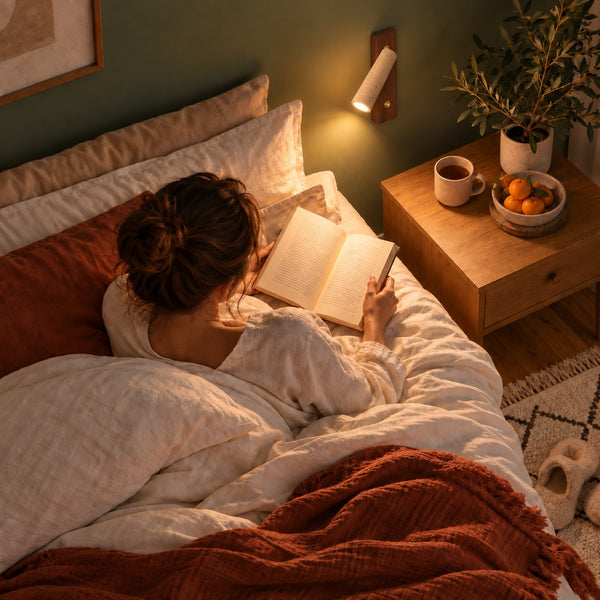




10 mistakes to avoid with a wall light
 By the Alméa team
8 min read
Sommaire
A badly chosen or badly placed wall light dazzles, looks lost on the wall or will not stay fixed in the partition. Here are the 10 mistakes to avoid with a wall light, from fitting height to fixing, each with the right approach.
The wall light is a demanding fitting: it sits at eye level, you see it both on and off, and its position is final once the wall has been drilled. A mistake of a few centimetres is noticeable every day.
Before drilling, take the time to check these ten points. They apply to a bedside wall light as much as to a row of wall lights in a hallway.
Contents
- Fitting the wall light at the wrong height
- Choosing a size out of proportion
- Forgetting the direction of the light
- Ignoring the IP rating
- Using the wrong wall plug
- Overlooking the cable outlet
- Spacing wall lights badly
- Mixing colour temperatures
- Forgetting the switch
- Letting the bulb dazzle
- In short
- Frequently asked questions
1. Fitting the wall light at the wrong height
Too low, the wall light dazzles people sitting down and gets knocked. Too high, it lights the ceiling and loses its purpose. The height depends on the room and the use: it is generally measured at the centre of the light or at the fixing point.
| Position | Indicative height from the floor |
|---|---|
| Living room, dining room | 1.60 to 1.80 m |
| Hallway, entrance | 1.70 to 1.90 m |
| Bedside | about 1.20 to 1.50 m, depending on the height of the bed |
| On either side of a mirror | at eye level, around 1.60 to 1.70 m |
| Staircase | about 1.80 to 2 m above the stair nosing |
For the distance from the ceiling, see our article how far from the ceiling to fit a wall light, and for the bedroom our guide to lighting a headboard.
2. Choosing a size out of proportion
A small wall light on its own on a large bare wall looks lost. A bulky wall light in a narrow hallway becomes an obstacle. Take two dimensions into account: the width in relation to the wall and the projection, that is the depth from the wall. In a passage less than a metre wide, keep the projection small, around 10 to 12 cm. Our guide to wall light shapes and sizes helps you find the right scale.

3. Forgetting the direction of the light
A wall light that shines upwards makes the room feel larger and creates a soft atmosphere. A wall light aimed downwards lights a specific area. A double-beam wall light does both. Choosing without thinking about it means risking a reading light that does not light the book, or a hallway light that leaves the floor in shadow.
| Light output | Effect | Recommended use |
|---|---|---|
| Upwards | Ambience, ceiling that opens up | Living room, bedroom, low ceiling |
| Downwards | Useful, precise light | Hallway, staircase, reading |
| Up and down | Graphic effect, wall highlighted | Entrance, living room, outside wall |
| Diffuse (stone, glass, fabric) | Soft halo all around | Bedside, dining room |
| Adjustable | Adjustable beam | Reading light, desk, painting |
The principle is explained in detail in direct, indirect and grazing light.
4. Ignoring the IP rating in damp rooms or outdoors
A standard indoor wall light, rated IP20, has no place near a shower or on an outside wall. In the bathroom, the zones defined by the wiring regulations (BS 7671) set a minimum rating: IPX4 in zone 2, for example. Outdoors, aim for at least IP44 under a porch roof and IP65 on a wall exposed to rain. Everything is summed up in our article to understand IP ratings in 5 minutes.
Natural stone, wood or metal: wall lights for every wall and every mood.
Discover our wall lights5. Using the wrong wall plug
A concrete wall plug will not hold in plasterboard, and a stone wall light weighing several kilos will pull out an undersized fixing. Identify the wall before buying the plugs: plasterboard, hollow brick, concrete or old stone. For stud partitions, follow our guide to fixing a wall light to plasterboard, and for heavy models the one on the weight of a stone wall light.
| Wall | Suitable fixing | Watch out for |
|---|---|---|
| Plasterboard | Metal cavity anchor | Reinforcement behind the board for a heavy wall light |
| Hollow brick | Long expansion plug or chemical anchor | Drill without hammer action so as not to break the cavities |
| Concrete, solid brick | Standard nylon plug | Masonry bit and hammer drill |
| Old stone | Long plug or chemical anchor | Aim for the stone, not the crumbly joint |
6. Overlooking the cable outlet
The wall light's backplate must cover the flush box, and the cable must come out in the right place. If the wire comes out at 1.50 m and you want the wall light at 1.75 m, you will have to chase the wall or choose another model. Check the size of the backplate and the position of the cable entry. If there is no outlet at all, our guide to hiding a wall light cable suggests alternatives.

7. Spacing wall lights badly
Wall lights placed too close together create overlapping pools of light. Too far apart, they leave dark areas between them. In a hallway, spacing of 2 to 3 metres is a good starting point, to be adjusted to the output. On either side of a bed or mirror, keep them symmetrical about the centre line. Our article on spacing wall lights in a row gives the calculations.

8. Mixing colour temperatures
A 4,000 K LED wall light next to a 2,700 K lamp paints two lights on the wall that do not go together. Choose the same colour temperature as the other sources in the room, generally 2,700 to 3,000 K in living spaces. Mineral materials such as travertine look especially beautiful in warm white.
9. Forgetting the switch
A bedside wall light you have to get up to switch off, or a pair of hallway lights without two-way switching, quickly becomes a nuisance. Think about the switch when choosing: switch built into the light, wall switch, pull cord or touch control. Our guide to adding a switch to a wall light presents the options.

10. Letting the bulb dazzle
A bare bulb visible at eye level, in a hallway or near a sofa, tires the eyes. Choose a model that hides the source, a low-intensity filament bulb or an orientation towards the wall. The lower the wall light, the more the source should be hidden.
Clean lines and controlled light output for a wall that never tires the eyes.
See the modern and design collection11. In short
Getting a wall light right starts with measuring: height, projection, spacing and position of the cable outlet. Then come the direction of the light, the IP rating and the colour temperature. To go through each step, from choosing to fitting, see our complete guide to wall lights and our method to install a wall light step by step.
Frequently asked questions
At what height should a wall light go in a living room?
Generally between 1.60 and 1.80 m from the floor. Above a sofa, fit it high enough that the source cannot be seen from the seat. Under a low ceiling, a model that shines upwards can go a little lower.
What distance between two wall lights?
In a hallway, allow 2 to 3 m between two wall lights. On either side of a bed or mirror, place them symmetrically, a few centimetres from the edges of the furniture or frame.
Which IP rating for a bathroom wall light?
It depends on the zone: IPX4 at least in zone 2, and a suitable light in zone 1. Outside the zones, a standard rating is enough, but IP44 gives more peace of mind in a damp room.
How do you fix a heavy wall light to plasterboard?
Use metal cavity anchors suited to the load or, better still, fix it to a stud or a reinforcement placed behind the board. Above a few kilos, a reinforcement is strongly recommended.
Can you fit a wall light without a cable outlet in the wall?
Yes: with a plug-in model whose cable is dressed or hidden in trunking, or with a rechargeable cordless wall light. Creating a new light point is possible, but means running a new circuit.
Which colour temperature for a wall light?
2,700 K for a warm atmosphere in the living room and bedroom, 3,000 K for the entrance or dining room. Keep 4,000 K for work areas such as a kitchen worktop or a workshop.
How many lumens for a wall light?
For ambient light, 200 to 400 lumens are enough. To light a hallway or a reading spot, aim for 400 to 800 lumens depending on the area and the colour of the walls.
Do you need an electrician to fit a wall light?
Not necessarily if there is a cable outlet and you are confident with basic wiring, with the breaker switched off. To create a new light point, or if in doubt, call an electrician.
Our lights for your home
Stone, wood, metal, rattan: real materials. Free delivery across the UK, returns within 90 days.
 -36 %
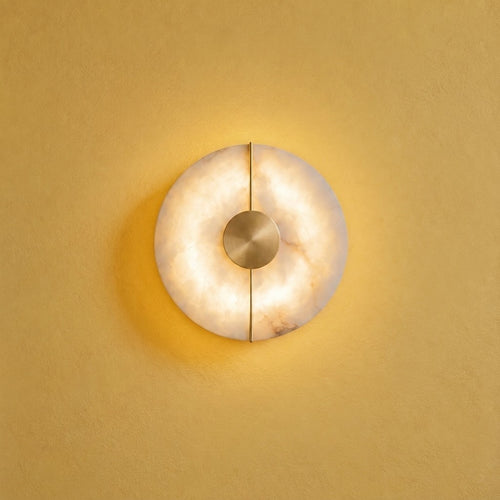
Marble wall light for bedroom, natural stone, alabaster white
£110.00
 -38 %
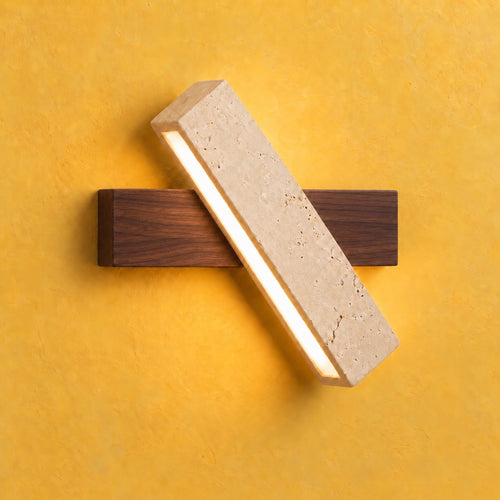
Natural stone wall light for living room, ambient lighting
£101.00
 -42 %
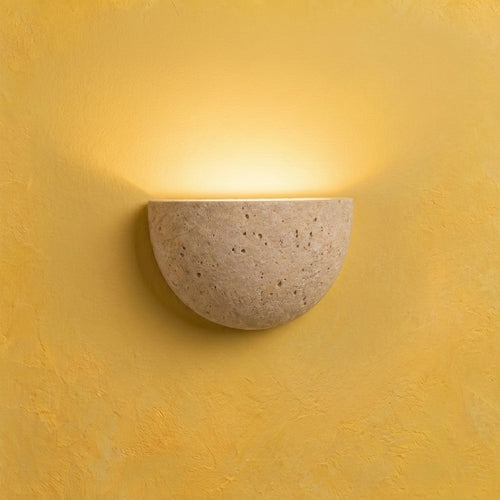
Travertine wall light for bedroom, natural stone, retro
£129.00
 -38 %
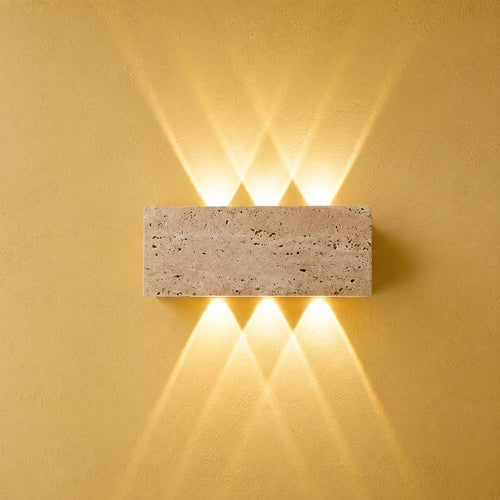
Travertine wall light for living room, natural stone, wabi-sabi
From £101.00
 Inspiration
 Room by room
 Inspiration