


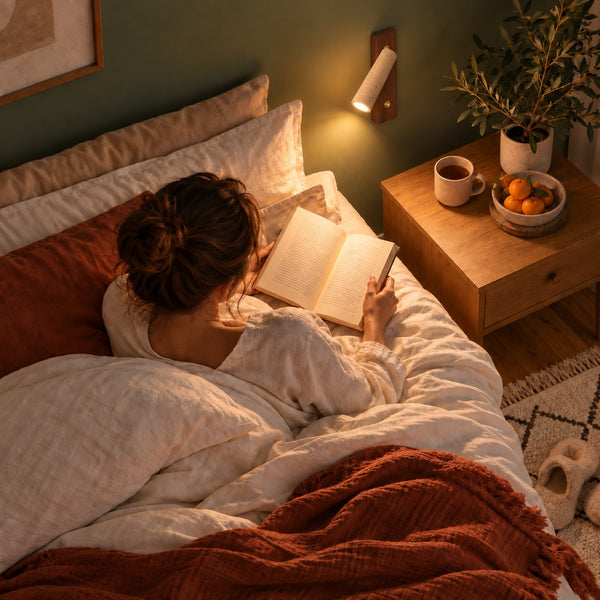


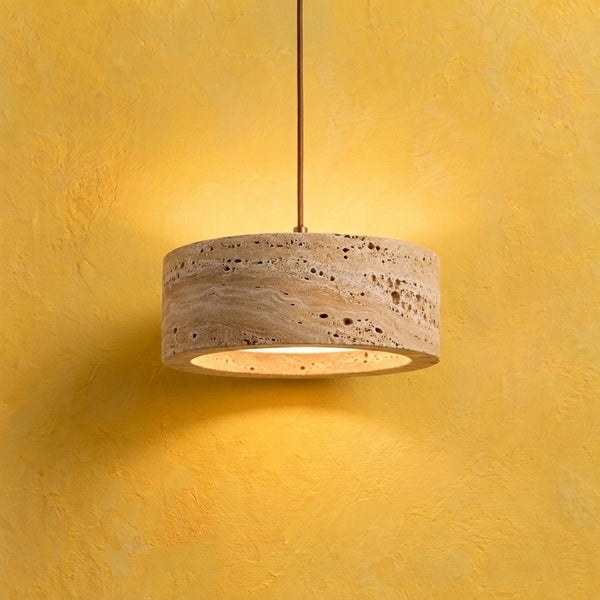


Wall lighting: every way to light a wall
 By the Alméa team
8 min read
Sommaire
Wall lighting turns a flat wall into a backdrop: it reveals it, colours it, makes it come alive or makes it float. Wall light, LED strip, spotlights, backlighting, wall washing, grazing light: here are all the ways to light a wall, their effects, the work they involve and how to choose for your room.
A lit wall makes a room look bigger, creates depth and is a good substitute for an overly powerful ceiling light. But each technique produces a very different effect: a crisp blade of light, a diffuse halo, raised texture or a perfectly even surface.
This guide goes through the solutions without bias, then helps you choose. For a specific wall, our dedicated articles are linked along the way.
Contents
1. What we mean by wall lighting
Wall lighting has two meanings: the light given off by a fitting fixed to the wall (wall light, light bar) and the light cast onto a wall by another source (ceiling spotlight, hidden strip, floor uplighter). In both cases, the wall becomes a surface that reflects light back into the room.
That explains why a lit wall feels so pleasant: the light reaches the eye indirectly, softly, without glare. The three main directions of light are explained in direct, indirect and grazing light.
2. The six ways to light a wall

| Technique | Effect on the wall | Work | Ideal for |
|---|---|---|---|
| Wall light | Halo, beams, decorative object | Wall light point | Every room |
| Wall washing | Even, bright surface | Recessed ceiling spotlights | Large wall, living room |
| Grazing light | Relief, shadows, texture | Source very close to the wall | Stone, brick, concrete |
| Indirect LED strip | Soft line of light | Profile, power supply | Cornice, niche, furniture |
| Backlighting | Halo behind an object | Strip behind a panel | Headboard, mirror, TV unit |
| Adjustable spotlight or track | Targeted pool of light | Ceiling or wall | Picture, object, shelf |
These techniques can be combined: a pair of wall lights for mood and a strip under a shelf for accent, for example.
3. The wall light: the most complete solution
The wall light is the only solution that lights the wall while being a decorative feature in its own right. Depending on its shape, it sends light upwards (indirect), downwards, both ways, or through its material, like stone that glows from within.
It is usually fitted between 1.60 and 1.80 m from the floor in a living space. On a long wall, allow one wall light roughly every 2 to 3 m: our article lighting a long bare wall details the calculation. It needs a wall light point; if there is none, see how to create a new light point.
Stone, wood or metal: our wall lights light the wall and dress it at the same time.
Discover our wall lights4. The modern wall light and its effects
The modern wall light plays more on the lighting effect than on the object. The most common shapes:
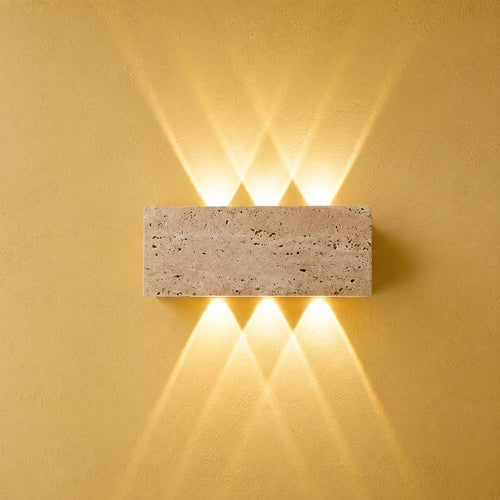
- Up and down: two opposing beams that draw two blades of light on the wall. See up and down wall light and our up and down LED travertine wall light.
- The disc or ring set off the wall: a circular halo around the shape, an eclipse effect.
- The bar or line: a horizontal light bar that highlights a piece of furniture or a mirror.
- The sculpted shape: in stone or metal, it creates its own shadows on the wall.
To find out more about contemporary shapes, read our guide to the designer wall light.
5. Wall washing: an evenly bright surface
Wall washing means flooding a wall with even light using wide-beam recessed spotlights in the ceiling. The wall becomes a large bright surface that lights the whole room by reflection, and the room looks bigger.
| Setting | Wall washing | Grazing light |
|---|---|---|
| Distance from the wall | 60 to 90 cm | 15 to 30 cm |
| Spotlight spacing | Roughly equal to the distance from the wall | 30 to 60 cm, or a continuous strip |
| Beam angle | Wide, 40° and above | Narrow, 10 to 25° |
| Effect | Smooth, even wall | Texture and relief revealed |
Wall washing suits smooth, light-coloured walls. On a textured wall, it flattens the relief. For choosing the angle, see narrow or wide beam.
6. Grazing light: bringing out the material
Grazing light places the source right next to the wall, so the light skims across it. Every bump casts a shadow: stone, brick, concrete or a lime plaster take on dramatic relief. It is the effect to aim for on an exposed stone wall, as we explain in grazing light and stone.

Be careful, it also shows up flaws: on badly finished plasterboard, every bump is visible.
7. LED strip and backlighting
LED strip fits anywhere: in a cornice, under a shelf, behind a headboard or a TV unit. Hidden away, it produces a soft line of light with no visible source. Fitted behind a panel set 5 to 10 cm off the wall, it creates a halo that makes the object float: that is the principle of backlighting.
- Choose a warm white of 2,700 to 3,000 K and a CRI of 90 or more.
- Fit it in an aluminium profile with a diffuser: it dissipates heat and avoids a dotted look.
- Plan an accessible place for the power supply.
To turn a single wall into a focal point in this way, see creating a feature wall with light.

8. Adjustable spotlights and pictures
To light a specific object on the wall, an adjustable spotlight on the ceiling, on a track or as a wall light focuses the light exactly where it is needed. For a picture, aim at the centre of the work at an angle of about 30° to the wall, to avoid reflections on the glass. A wall light above the frame also works, fitted 20 to 30 cm above the top edge. Details in lighting a picture or frame and adjustable spotlight wall light.
9. Choosing for your wall

| Your wall | Recommended technique |
|---|---|
| Stone, brick, raw concrete | Grazing light, or up and down wall light |
| Smooth and light-coloured | Wall washing or halo wall lights |
| Dark colour | More powerful wall lights, directed light |
| Patterned wallpaper | Wall light with soft upward light |
| Headboard wall | Bedside wall lights or backlighting |
| Rented home, no work | Plug-in wall light, battery-powered strip |
A dark wall absorbs a lot of light: plan for more lumens. The right amount for each shade is explained in getting the light right for the colour of your walls.
Clean shapes for modern wall lighting: blades, halos and beams.
Discover the modern design collection10. Lumens, kelvins and safety
For mood wall lighting, a wall light of 300 to 600 lumens is enough in a living room, 150 to 300 lumens in a bedroom. An indirect mood strip needs only low power, a few watts per metre. Keep one colour temperature for all the wall light sources in the room, 2,700 or 3,000 K.
11. In short
To light a wall, choose the effect before the technique: a wall light to light and decorate at once, wall washing for an evenly bright surface, grazing light to bring out a material, LED strip and backlighting to make a volume float, a spotlight for a picture. Match the output to the colour of the wall, keep a single colour temperature and leave the connections to a professional if in doubt.
Frequently asked questions
How do you light a wall without a wall light?
With recessed ceiling spotlights for wall washing, an LED strip hidden in a cornice or behind furniture, or adjustable spotlights on a track. Each technique gives a different effect.
What is the difference between wall washing and grazing light?
Wall washing places the spotlights 60 to 90 cm from the wall for even light. Grazing light places the source 15 to 30 cm away to reveal texture.
How high should a wall light be fitted?
Between 1.60 and 1.80 m from the floor in a living space, so that the bulb is not visible to someone standing. Heights are different in a bedroom and on a staircase.
How many wall lights to light a wall?
Allow one wall light roughly every 2 to 3 m on a long wall, and a pair to frame a sofa, a bed or a piece of furniture.
What light for a stone wall?
Grazing light or a double-beam wall light, in a warm white of 2,700 to 3,000 K, which brings out the warmth of the stone.
Can you light a wall with LED strip?
Yes, indirectly in a cornice or behind a panel. Fit it in a profile with a diffuser and choose a warm white with a good CRI.
How do you light a dark-coloured wall?
Plan for more lumens, since a dark wall absorbs light, and favour directed light that creates pools of light rather than diffuse lighting.
What is a modern wall light?
A wall light with simple shapes (line, disc, half circle) that plays on the effect of the light cast on the wall, often with integrated LED and sometimes a double beam.
Our lights for your home
Stone, wood, metal, rattan: real materials. Free delivery across the UK, returns within 90 days.
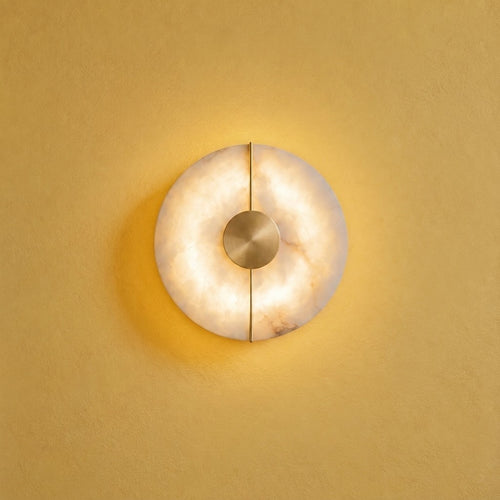 -36 %
Marble wall light for bedroom, natural stone, alabaster white
£110.00
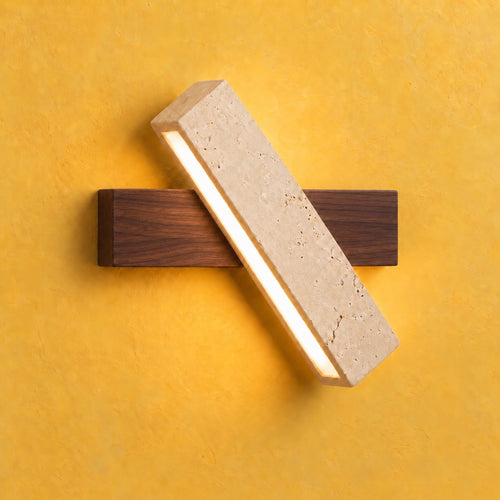 -38 %
Natural stone wall light for living room, ambient lighting
£101.00
 -42 %
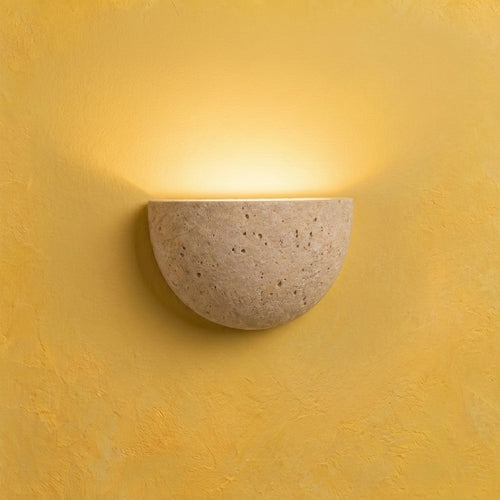
Travertine wall light for bedroom, natural stone, retro
£129.00
 -38 %
Travertine wall light for living room, natural stone, wabi-sabi
From £101.00
 Room by room
 Inspiration
 Room by room