






Wall light above a living room or hallway mirror: the guide
 By the Alméa team
9 min read
Sommaire
A wall light above a living room or hallway mirror turns a simple reflection into a point of light that makes the room feel bigger and lights your face before you go out. You still need the right width, the right height and a light that does not reflect straight into your eyes: here are the figures for getting it right.
A living room or hallway mirror does not have the same role as a bathroom one: you check an outfit as you pass, and it reflects light back into the room. The wall light above it must therefore decorate, light a face and never dazzle in the reflection.
If you are looking for bathroom mirror lighting, with its zones and protection ratings, see our guide to lighting a bathroom mirror without shadows on the face. Here, we stay in dry rooms: hallway, living room, corridor, dining room.
Contents
- Why a wall light above a mirror
- Above or on each side?
- The width of the wall light
- The fitting height
- Projection, the detail that changes everything
- Avoiding glare in the reflection
- Lumens, kelvins and colour rendering
- The hallway mirror
- The living room mirror
- Which material in front of a mirror
- Fixing and power supply
- In short
- Frequently asked questions
1. Why a wall light above a mirror
A mirror without its own light stays dark in the evening, and the central ceiling light lights your back when you look at yourself. A wall light fitted just above it lights your face from the front and creates a second point of light in the mirror, visually doubling the lighting.
The reflection also gives the wall depth and makes small hallways feel bigger, a principle described in mirror and wall light, the duo that makes a room feel bigger.
2. Above the mirror or on each side?
A single wall light above suits wide mirrors and narrow hallways. Two wall lights on either side give a more flattering light, with no shadows under the eyes, but need width.

| Layout | Ideal for | Limit |
|---|---|---|
| One wall light above | Landscape mirror, narrow hallway, mirror over a console | Slight shadow under the chin if the light is too high |
| Two side wall lights | Portrait mirror, spacious hallway, decorative symmetry | About 30 cm of clear space needed on each side |
| Wall light above + lamp on the console | Living room, furnished hallway | Two sources whose colour temperature must match |
| Twin-head double wall light | Medium mirror, single connection point | Choose a model with adjustable heads |
If you are unsure, our guide to the double wall light explains how to get two beams from a single cable outlet.
3. The width of the wall light in relation to the mirror
A wall light above a mirror is between half and two thirds of its width. Narrower, it looks lost; wider, it overwhelms the arrangement. For a round mirror, aim for a third to half of the diameter.
| Mirror width | Recommended wall light width | Type of model |
|---|---|---|
| 40 to 50 cm | 20 to 30 cm | Compact wall light, small bowl, spotlight |
| 60 to 80 cm | 30 to 50 cm | Short light bar, double wall light |
| 90 to 120 cm | 50 to 80 cm | Long LED wall light, bar |
| Over 120 cm | Two spaced wall lights | Two identical models at one third and two thirds |
4. The fitting height above the frame
Place the bottom of the wall light 10 to 20 cm above the top of the frame. Any closer, and the light hits the glass and creates a shiny reflection; any higher, and it lights the top of the head and deepens the shadows under the eyes. In most hallways, the top of a mirror is around 170 to 190 cm from the floor, so the wall light ends up at about 185 to 210 cm.
If your ceiling is low, check that at least 15 to 20 cm remains between the wall light and the ceiling, otherwise the halo gets squashed. Our article on the distance between a wall light and the ceiling gives all the guidelines. For side wall lights, the rule changes: their centre goes at eye level, between 150 and 165 cm from the floor, and 10 to 15 cm from the edge of the mirror.
5. Projection, the detail that changes everything
Projection is how far the wall light sticks out from the wall. Too flat, and the wall light only lights the frame; a projection of 10 to 20 cm throws the light towards the face. In a hallway people walk through, however, avoid more than 25 cm of projection below a height of 190 cm. An adjustable wall light lets you aim the beam down and forward.
6. Avoiding glare in the reflection
A bare source is seen twice, directly and in the reflection. Three rules stop you being dazzled every time you walk past.

- Choose a concealed source: opal diffuser, translucent stone, shade, or LED aimed downwards under a profile.
- Check the angle: from 1 m in front of the mirror, you should not see the source in the reflection, only its light.
- Prefer downward light or up and down light rather than a globe that shines in every direction.
Our article on glare and the UGR index explains why a bare source is so tiring.
Wall lights with a soft, diffused glow, designed to be seen as much as to light.
Discover our wall lights7. Lumens, kelvins and colour rendering
There is no need for the output of a make-up station: you want an accent light that adds to the general lighting.
| Use | Recommended output | Colour temperature | CRI |
|---|---|---|---|
| Living room mirror, decor | 200 to 400 lumens | 2700 to 3000 K | 80 minimum |
| Hallway mirror, checking your outfit | 400 to 800 lumens | 3000 K | 90 recommended |
| Corridor or landing mirror | 200 to 400 lumens | 2700 to 3000 K | 80 minimum |
3000 K stays warm while letting you judge the colour of an item of clothing. See our comparison 2700K, 3000K or 4000K.

8. The hallway mirror: seeing yourself before you go out
In the hallway, you check your hair, a collar, how colours go together: the wall light must light the face and upper body evenly. A light bar or two side wall lights do the best job, controlled from the switch by the door. Our guide to the hallway wall light covers the whole space.
9. The living room mirror: decor first and foremost
In the living room, the large mirror above a fireplace, a sideboard or a sofa is first of all a decorative feature. Soft lighting is best, on a dimmer if possible. Above a fireplace, a pair of side wall lights remains the most balanced arrangement; above a sofa, a single wall light with little projection. See our guide to the living room wall light.
10. Which material in front of a mirror
A mirror amplifies reflections, the veins of stone and the warmth of wood.

- Natural stone and travertine: light filtered through stone gives a soft halo, with no bright spot, ideal facing a mirror. The reflection reveals the material from both sides.
- Black or gold metal: graphic and crisp, it highlights a slim frame. Choose a matt finish to limit stray reflections.
- Wood: it warms up a mirror with a simple frame and goes well with a wooden console table.
Our stone and travertine lights are particularly well suited to this use, precisely because the source stays hidden behind the stone.
11. Fixing and power supply
The cable outlet is rarely in the right place. Create a light point, run trunking along the frame or hide the cable behind the mirror: see our 7 tips for hiding a wall light cable. For fixing, locate the studs in the partition and use the right fixing to fix a wall light to plasterboard.
Clean lines and graphic shapes to go with a contemporary mirror.
See the modern and design collection12. In short
A wall light above a mirror is half to two thirds of its width, is fitted 10 to 20 cm above the frame and projects about ten centimetres. Source invisible in the reflection, light around 3000 K: in the hallway it helps you see yourself, in the living room it serves the decor.
Frequently asked questions
At what height should a wall light go above a mirror?
The bottom of the wall light goes 10 to 20 cm above the top of the frame. With a mirror whose top is at about 180 cm, the wall light ends up at about 190 to 200 cm from the floor. Keep at least 15 cm below the ceiling.
What width of wall light for an 80 cm mirror?
Aim for 40 to 55 cm, between half and two thirds of the mirror's width. A shorter wall light will look lost, a longer one will overwhelm the arrangement.
Is one wall light above or two on each side of the mirror better?
Two side wall lights light the face better, with no shadows under the eyes, but need about 30 cm of clear space on each side. A single wall light above suits wide mirrors and narrow hallways.
How do you avoid reflections of a wall light in a mirror?
Choose a source concealed by a diffuser, stone or shade, aimed downwards. Fit the wall light at least 10 cm above the frame and check from your usual position that the source cannot be seen in the reflection.
Which colour temperature above a hallway mirror?
3000 K is the best compromise: warm but neutral enough to judge the colours of an outfit. Pair it with a CRI of 90 if possible for true colours.
How many lumens to light a living room mirror?
In the living room, 200 to 400 lumens is enough, as the wall light is for ambience. In a hallway where you check your outfit, go up to 400 to 800 lumens.
Can you put a cordless wall light above a mirror?
Yes, in a rented home or where there is no cable outlet. Check that the light is sufficient and that charging is possible without taking the mirror down.
Is a stone wall light suitable above a mirror?
Yes, it is even one of the most beautiful options: the stone hides the source and gives a soft halo, with no bright spot in the reflection. In a dry room such as the hallway or living room, no special precautions are needed.
Our lights for your home
Stone, wood, metal, rattan: real materials. Free delivery across the UK, returns within 90 days.
 -36 %
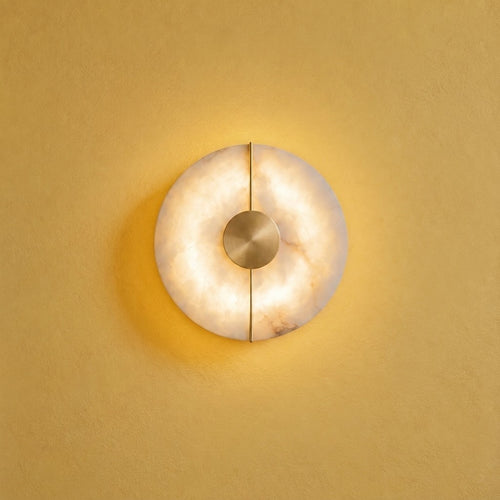
Marble wall light for bedroom, natural stone, alabaster white
£110.00
 -38 %
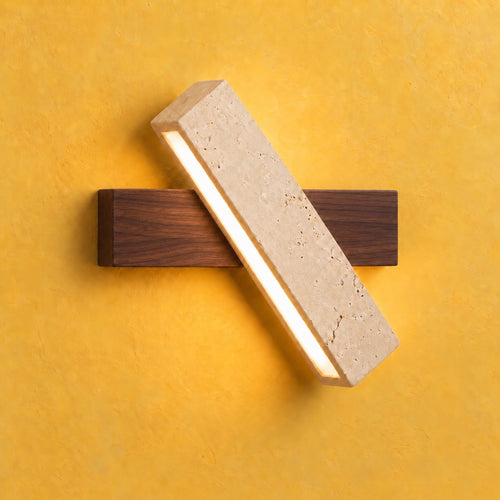
Natural stone wall light for living room, ambient lighting
£101.00
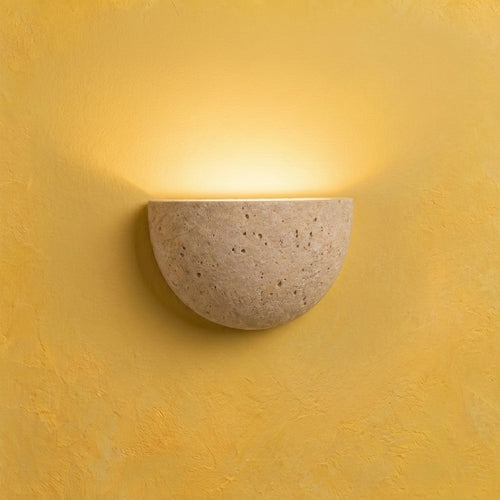 -42 %
Travertine wall light for bedroom, natural stone, retro
£129.00
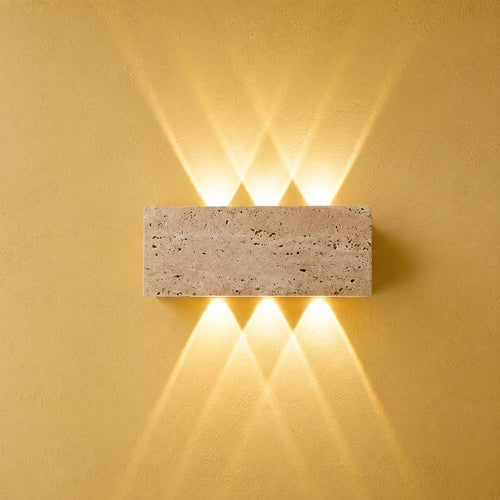 -38 %
Travertine wall light for living room, natural stone, wabi-sabi
From £101.00
 Pendant lights
 Pendant lights
 Pendant lights