






Rattan, wicker, bamboo, seagrass: natural fibres for lighting compared
 By the Alméa team
8 min read
Sommaire
Rattan, wicker, bamboo, seagrass: these four natural fibres look alike in photos, but they do not give a light the same glow, the same shapes or the same lifespan. This comparison of lighting fibres helps you choose the right material for the room, the style and the bulb.
In shops, everything is often filed under the label “natural fibres”. Yet rattan is a climbing palm cane, wicker a willow rod, bamboo a hollow grass and seagrass a marsh plant twisted into cord. Their structure explains everything else: flexibility, stiffness, fineness of the weave, reaction to humidity.
Contents
- What really sets the four fibres apart
- The big fibre comparison table
- Rattan: flexibility and enveloping shapes
- Wicker: fine, country-style weaving
- Bamboo: stiffness and graphic lines
- Seagrass: raw, matt cord
- Light and shadow by fibre
- Which fibre for which room?
- Bulb, heat and safety
- Care and longevity
- In short
- Frequently asked questions
1. Rattan, wicker, bamboo, seagrass: what really sets the four fibres apart
The difference is not the colour, which can be stained or bleached, but the shape of the stem. Rattan is a solid, flexible cane, steam-bent to create curves. Wicker is a thin, even rod, soaked before being tightly woven. Bamboo is a hollow tube split into flat, stiff strips. Seagrass, for its part, is a grass twisted into cord before being coiled or knotted.
The direct result: rattan lends itself to large domed shapes, wicker to fine, dense baskets, bamboo to geometric structures and woven strips, seagrass to spiral shades with a raw look. For details, see our guide to the rattan pendant light.
2. The big lighting fibre comparison table

| Criterion | Rattan | Wicker | Bamboo | Seagrass |
|---|---|---|---|---|
| Origin | Climbing palm cane | Willow rod | Grass with a hollow stem | Twisted marsh grass |
| Worked form | Solid cane, bent | Thin rod, woven | Flat strips, woven | Coiled cord |
| Flexibility | High | Medium | Low | High |
| Typical shapes | Domes, globes, XL bells | Baskets, dense bells | Woven ceiling lights, geometric shapes | Spiral shades, globes |
| Natural colour | Golden honey | Blond to brown depending on peeling | Straw blond, slightly glossy | Soft green turning beige |
| Light effect | Wide, graphic shadows | Softened light, few shadows | Regular, crisp patterns | Heavily filtered light, cocoon |
| Sensitivity to dry air | Medium | High | Medium (risk of splitting) | Low |
| Associated style | Boho | Country | Japandi | Raw natural |
3. Rattan: flexibility and enveloping shapes
Rattan comes from South East Asia. Its solid cane, from a few millimetres to over two centimetres in diameter, can be bent without breaking. It is the fibre of large dome pendants 40 to 60 cm in diameter, airy globes and pieces with an openwork weave.
In terms of light, an openwork rattan weave casts generous shadows on the ceiling and walls. A tight weave, on the other hand, gives a soft golden halo. To size and hang a large model, our article on the rattan chandelier gives the recommended heights and diameters.
4. Wicker: fine, country-style weaving
Wicker comes from young shoots of cultivated willow, harvested in winter. The thin, long rods are woven tightly after soaking. It produces bells and baskets that are denser and more regular than rattan, with the charm of traditional basketry.
Its weak point is very dry air: next to a radiator or under an overheated ceiling, the rods can become brittle. Our comparison wicker or rattan explains how to tell them apart in a shop.
5. Bamboo: stiffness and graphic lines
Bamboo is not a wood but a grass. Its hollow stem is split into flat strips, which are woven into mats or assembled into structures. Stiffer than rattan, it suits woven ceiling lights, cylinders, conical shapes and the clean lines favoured in Japanese-inspired and Japandi interiors.
Woven strips create very regular, almost graphic patterns when light passes through. Our hand-woven rattan and bamboo ceiling light shows this effect well in a compact diameter.
6. Seagrass: raw, matt cord
Seagrass is a wetland grass, dried and then twisted into cord. Green when harvested, it takes on a straw beige tone over time. In lighting, it is coiled in a spiral around a frame or knotted to form dense shades with a very matt look.

It filters light more than openwork rattan: it is used for a cocoon atmosphere rather than to light a table. For related fibres such as straw, raffia or jute, see our guide to straw, raffia, jute or seagrass pendant lights.
Woven rattan, woven bamboo: discover our natural fibre lights, designed for a warm and lively light.
Discover our bamboo and rattan lights7. Light and shadow: what each fibre does with your bulb
More than the material, it is the density of the weave that determines the effect. The same rattan can give a clear or a softened light depending on the gap between the strands. This table sums up the effect and the suitable use.
| Type of weave | Light effect | Recommended use |
|---|---|---|
| Openwork rattan, wide mesh | Shadows cast on the ceiling | Living room, entrance, ambience |
| Tight wicker or rattan | Golden halo, few shadows | Bedroom, extra reading corner |
| Bamboo in woven strips | Regular, crisp pattern | Living room, study, Japandi style |
| Coiled seagrass | Heavily filtered light | Bedroom, relaxation corner |
To learn more about the warmth of materials, our article wood, rattan, paper and fabric explains why these fibres visually warm a room.

8. Which fibre for which room?
Above a table, choose a model that is open at the bottom, in rattan or bamboo, hung 65 to 80 cm above the tabletop. In a bedroom, a tight wicker or seagrass weave avoids glare when lying down.
| Room | Recommended fibre | Why |
|---|---|---|
| Living room | Openwork rattan, bamboo | Large shapes, decorative shadows |
| Dining room | Rattan, bamboo | Shapes open towards the table |
| Bedroom | Tight wicker, seagrass | Soft light, no glare |
| Kitchen | Bamboo, varnished rattan | Surfaces that are easier to dust |
In the bathroom, natural fibres should be avoided in the zones close to water. Style counts too: rattan calls for a boho look with rattan and linen, while wicker and seagrass go very well with a seaside style.
9. Bulb, heat and safety in a natural fibre
All these fibres are combustible. The simple rule: an LED bulb, which gives off little heat, and never a halogen or incandescent bulb in a woven shade. An 806 lumen E27 LED uses about 7 to 8 W, compared with 60 W for the equivalent old incandescent bulb, and so gives off much less heat.

Leave a few centimetres of air between the bulb and the fibre, and choose a 2700 K warm white that brings out the honey tones. Our dedicated guide to the bulb for a rattan, bamboo or paper pendant details shapes, wattages and bases.
10. Care and longevity by fibre
Dust is the common enemy: a feather duster or soft brush every week, a low-power vacuum with a brush attachment every month. Bamboo is cleaned dry. Seagrass is brushed in the direction of the twist.
Avoid direct sunlight behind a window, which fades all fibres within a few seasons. The step-by-step method is in our article on cleaning a rattan or bamboo pendant.
Fancy a woven pendant above the table or the sofa? Browse our rattan models.
See our rattan pendant lights11. In short
Choose rattan for large shapes and shadows, wicker for a fine, country-style weave, bamboo for clean lines and a regular pattern, seagrass for heavily filtered light with a raw look. In every case: a warm white LED bulb and regular dusting. For wall lights, our guide to the rattan wall light completes this comparison.
Frequently asked questions
What is the difference between rattan and wicker?
Rattan is a solid cane from a climbing palm, flexible and thick, bent to make large shapes. Wicker is a thin willow rod, woven tightly after soaking.
Is bamboo stronger than rattan?
Bamboo is stiffer but less flexible: it resists deformation well, but knocks on the edge of the strips less well. Rattan bends without breaking.
Which bulb should go in a rattan pendant?
An LED bulb in warm white 2700 K, from 470 to 806 lumens depending on the room. Avoid halogen and incandescent bulbs, which get too hot close to a natural fibre.
Can you put a rattan pendant in a bathroom?
It is not recommended near the shower or bath: humidity and splashes damage the fibre, and the light must meet the IP rating required for the zone.
How can you recognise seagrass?
Seagrass comes as a twisted cord with a matt look, greenish when new and then beige. It is rougher than rattan and has neither the flat strips of bamboo nor the round rods of wicker.
Does rattan yellow over time?
Yes, natural rattan develops a patina and darkens slightly towards a deeper honey, especially in the light. It is a normal and much appreciated change.
Which fibre makes the most beautiful shadows?
Openwork rattan with a wide mesh casts the most spectacular shadows on the ceiling. Strip bamboo gives a more regular pattern. Tight wicker and seagrass give more of a halo without distinct shadows.
How do you dust a natural fibre light?
Switch off the power, then run a soft brush or a wide paintbrush in the direction of the weave. Avoid using much water or household cleaners.
Our lights for your home
Stone, wood, metal, rattan: real materials. Free delivery across the UK, returns within 90 days.
 -36 %
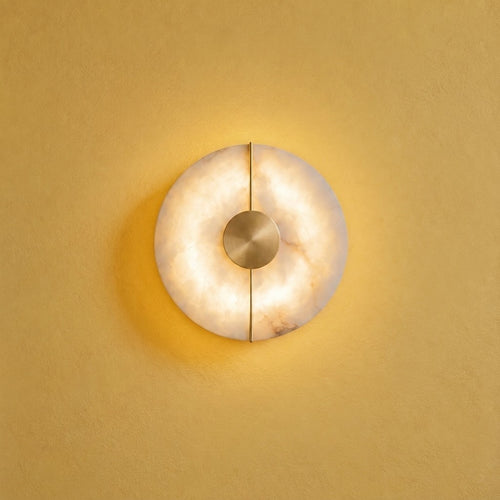
Marble wall light for bedroom, natural stone, alabaster white
£110.00
 -38 %
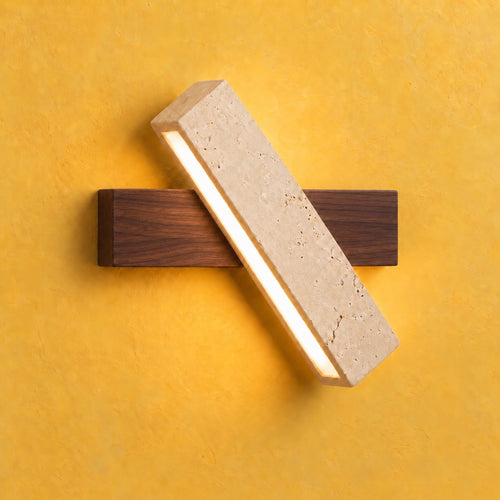
Natural stone wall light for living room, ambient lighting
£101.00
 -42 %
Travertine wall light for bedroom, natural stone, retro
£129.00
 -38 %
Travertine wall light for living room, natural stone, wabi-sabi
From £101.00
 Wall lights
 Guide pratique
 Wall lights