





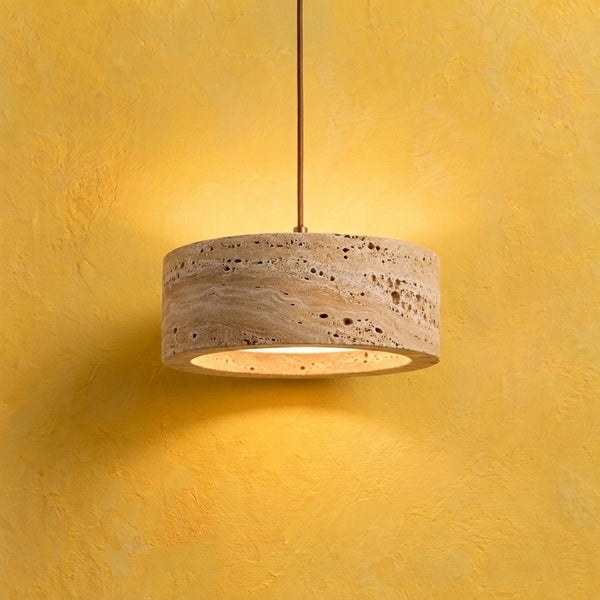


10 mistakes to avoid when choosing a pendant light
 By the Alméa team
8 min read
Sommaire
Choosing a pendant light seems simple, until the day it dazzles your guests, looks tiny above the table or refuses to stay up on the ceiling. Here are the 10 mistakes to avoid when choosing a pendant light, with the right guidelines for height, diameter and fixing.
The pendant is often the most visible light in a room. It structures the space, marks out the table or island and sets the tone for the whole decor. A mistake in size or height is therefore noticeable every day.
The good news: most of these mistakes can be prevented with a tape measure and a few minutes spent reading the product sheet. Here is what to check before ordering.
Contents
- Getting the height wrong
- Choosing the wrong diameter
- Forgetting the weight and the ceiling
- Confusing ambient light and directed light
- Making it the only light source in the room
- Overlooking the fitting and the bulb
- Ignoring the position of the ceiling outlet
- Forgetting the cable length
- Choosing a material unsuited to the room
- Underestimating a low ceiling
- In short
- Frequently asked questions
1. Getting the pendant height wrong
Too high, the pendant lights the ceiling and leaves the table in a diffuse, flat light. Too low, it blocks the view between guests or becomes an obstacle in a walkway. It is the most common mistake, and the easiest to avoid.
| Position | Indicative height |
|---|---|
| Above a dining table | 75 to 85 cm between the tabletop and the bottom of the shade |
| Above a kitchen island | 65 to 80 cm above the worktop |
| Walkway (hall, living room) | at least 2.10 m between the floor and the bottom of the light |
| Bedside (low pendant) | about 50 to 70 cm above the mattress |
Every case, room by room, is covered in our guide to pendant light height.
2. Choosing the wrong diameter
On a product photo with nothing for scale, a 20 cm pendant and a 45 cm pendant look alike. Once on the ceiling, the first may look lost above a large table, the second may overwhelm a small kitchen.

Two simple guidelines: above a table, the diameter is half to two thirds of its width; in the centre of a room, it increases with the floor area. For a long table, two or three small pendants in a row often work better than a single large one.
| Situation | Indicative diameter |
|---|---|
| Table 80 to 90 cm wide | 40 to 60 cm, or 2 to 3 pendants of 20 to 30 cm |
| Round table of 110 cm | 55 to 70 cm |
| Room of 10 to 12 m² | 30 to 40 cm |
| Room of 20 to 25 m² | 50 to 70 cm |
To fine-tune, read our article on what size of light to choose.
3. Forgetting the weight and the type of ceiling
A rattan pendant weighs a few hundred grams, a stone or metal chandelier several kilos. Yet a plasterboard, hollow block or panelled ceiling does not take every load in the same way. Check the weight on the product sheet, then the type of ceiling, before ordering. For a heavy model, our guide to fixing a heavy chandelier to the ceiling details the right wall plugs and reinforcements.
4. Confusing ambient light and directed light
An opaque metal shade sends all the light downwards: perfect above a table or an island, disappointing if it has to light the whole room. Conversely, a woven or paper pendant spreads light in every direction but lights a worktop less precisely.
| Type of shade | Resulting light | Ideal use |
|---|---|---|
| Opaque dome or bell | Directed downwards | Table, island, desk |
| Rattan, bamboo, woven fibres | Diffuse, with shadow patterns | Living room, bedroom, dining area |
| Stone (travertine, alabaster) | Filtered, warm and soft | Ambience, dining room |
| Opal glass or paper | Diffuse and even | Soft general lighting |
5. Making it the only light source in the room
A pendant, however generous, leaves the walls and corners in shadow. On its own, it makes the room look flat. Plan for at least one wall light or extra lamp alongside it. Our guide to the rules for a living room pendant shows how to fit it into a complete lighting plan.
Woven rattan, wood, natural stone or metal: find the pendant light that suits your room.
Discover our pendant lights6. Overlooking the fitting and the bulb
Many pendant lights are sold without a bulb. Before buying, note the fitting (E27, E14, G9), the maximum wattage allowed and the shape of the bulb, especially if it stays visible under the shade. In a natural fibre pendant, an LED bulb that gives off little heat is the only sensible option. Our article which bulb for a rattan, bamboo or paper pendant will guide you.

7. Ignoring the position of the ceiling outlet
The connection point on the ceiling is rarely above the table. If you hang the light where the wire comes out, it will light the empty space next to the table. The solution is an offset pendant: a ceiling hook moves the light to the right spot. Everything is explained in our guide to the offset chandelier above the table.

8. Forgetting the cable length
A cable that is too short stops you lowering the pendant to the right height under a ceiling of 2.70 m or more. A cable that is too long must be shortened or neatly coiled. Measure the ceiling height, subtract the height you want below the light, and compare with the stated cable length. Our method for shortening a pendant cable saves you unpleasant surprises.
9. Choosing a material unsuited to the room
Above a hob, a woven shade catches grease and becomes hard to clean. In a bathroom, humidity calls for a light suited to the zones and the IP rating. Choose the material with care in mind too: our guide to cleaning a rattan or bamboo pendant shows what natural fibres need.

10. Underestimating a low ceiling
Under a 2.40 m ceiling, a bulky pendant that is not above a table becomes an obstacle and overwhelms the room. Choose a flat model, a woven ceiling light or a pendant placed only above a piece of furniture nobody walks through.
Clean shapes that find their place even under a standard ceiling.
See the modern and design collection11. In short
Before choosing a pendant light, measure three things: the ceiling height, the width of the table or area to be lit, and the position of the ceiling outlet. Then check the weight, the fitting and the cable length. For the full picture, our complete guide to pendant lights goes through every step, from buying to fitting.
Frequently asked questions
At what height should a pendant hang above a table?
Allow 75 to 85 cm between the tabletop and the bottom of the shade. This height lights the table well without blocking the view between guests. Under a very high ceiling, you can go a little higher, but never more than a metre.
What pendant diameter for a 6-seater table?
For a rectangular table of 180 cm by 90 cm, aim for a pendant of 45 to 60 cm, or two to three pendants of 20 to 30 cm in a row. The light should not extend beyond the edges of the table.
How do I know if my ceiling can take a heavy pendant?
First identify the material by tapping the ceiling: plasterboard, concrete, hollow blocks or wood. Above a few kilos in plasterboard, you need a suitable fixing or a reinforcement. If in doubt, have it checked by a professional.
Which bulb should go in a rattan pendant?
A warm white LED bulb, 2,700 K, that gives off little heat. Respect the stated maximum wattage and leave a few centimetres between the bulb and the fibre.
How do you centre a pendant if the wire is not in the right place?
Use an offset hook on the ceiling: the cable runs from the existing outlet and the light hangs from the hook, above the table. It is a simple solution that avoids creating a new ceiling outlet.
One or several pendants above a long table?
For tables over 1.80 m long, two or three pendants in a row spread the light better than a single one. Space them 60 to 80 cm apart and leave about 30 cm between the last one and the end of the table.
Can you hang a pendant with a 2.40 m ceiling?
Yes, above a table, an island or a bed, where nobody walks underneath. Elsewhere, choose a flat model or a ceiling light that keeps 2.10 m of clear headroom.
What is the difference between a pendant light and a chandelier?
In everyday use, a chandelier is a pendant with several arms or several lights, often more decorative. Pendant light is a broader term that also covers single-light models.
Our lights for your home
Stone, wood, metal, rattan: real materials. Free delivery across the UK, returns within 90 days.
 -8 %
Travertine pendant light for living room, Japanese wabi-sabi, stone Ø 15 cm
£141.00
 -21 %
Travertine and wood pendant light for living room and dining room, Ø 20 cm
£141.00
 -25 %
Yellow travertine pendant light for living room, natural stone Ø 20 cm
£154.00
 3-light pendant light for living room, black metal, vintage, E27 fitting
£73.00
 Wall lights
 Inspiration
 Room by room